Engineering-Grade Filaments Explained: PA-CF, PC, ASA and When to Use Them
The materials side of 3D printing has grown up. There was a time the whole decision was PLA or ABS and not much else. Now the engineering-grade range stretches from food-safe parts to structural components that wouldn't look out of place on an aircraft. Knowing what each one really gives you — and where it lets you down — is the difference between specifying something that lasts and something that fails in the field.
Why these materials exist at all
PLA prints easily and looks fine, but it goes soft around 60°C. Leave a part on the dash on a summer day and it'll sag. It's brittle under a knock, and sunlight breaks it down. For a display model or a low-stress prototype, none of that matters. For a part doing a real job in the real world, all of it does.
Engineering filaments give up some of that easy printing in exchange for properties you can actually lean on. They tend to want hotter nozzles, enclosed chambers and careful attention to moisture — which is exactly why results vary so much from one supplier or operator to the next.
The materials worth knowing
PA12 (Nylon 12)
Your way into structural Nylon. Good impact resistance, decent chemical resistance, and it holds shape up to around 100–110°C. It's tougher and more flexible than ABS, which makes it a natural fit for snap-fits, living hinges and anything that gets flexed over and over. The catch is water: Nylon pulls moisture out of the air, and damp filament prints badly. Drying and sealed storage aren't optional.
PA6-CF (carbon-fibre reinforced Nylon 6)
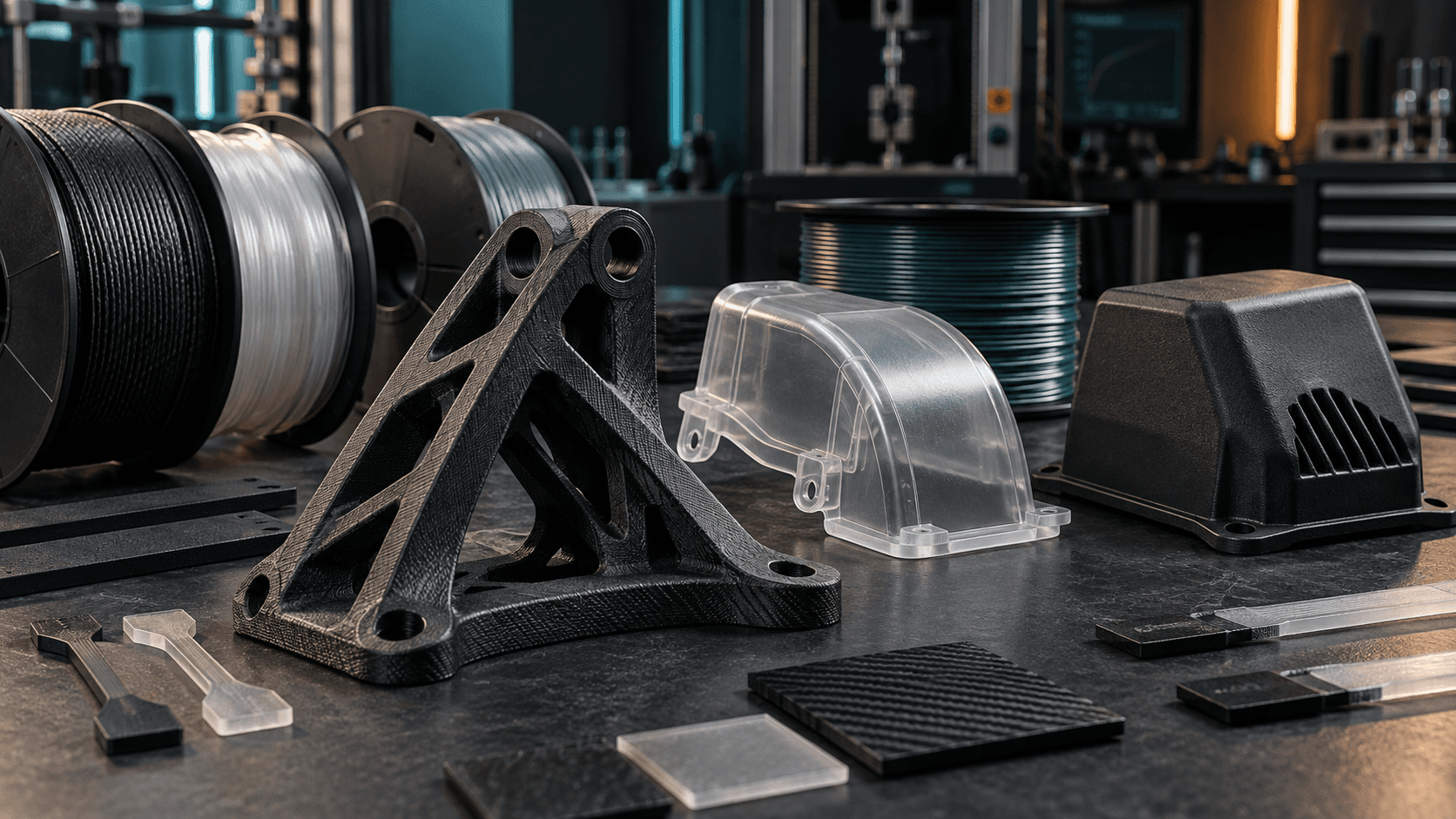
Adding chopped carbon fibre changes Nylon's character completely. PA6-CF comes out stiff and dimensionally stable — closer to aluminium than plastic in feel — while staying far lighter, and it holds up past 160°C. This is the one for structural brackets, housings that have to stay flat under load, and anywhere stiffness-to-weight is the priority. In return it's abrasive enough to need a hardened nozzle, and it gives up some of the impact toughness you'd get from plain Nylon.
PC (polycarbonate)
One of the toughest polymers you can print — the same stuff in riot shields and aircraft canopies. Heat resistance is excellent (HDT around 110–130°C depending on the grade) and it's naturally clear. It's a fussy print, though: a genuinely hot nozzle (260–300°C), a bed over 100°C, and an enclosure or it warps. Get it right and it's worth the trouble for anything that has to take a hit and stay stable in heat.
ASA (acrylonitrile styrene acrylate)
Think of it as ABS's better-behaved cousin with one big upgrade — it doesn't mind the sun. Where ABS yellows, cracks and turns brittle outdoors, ASA keeps its properties for years. For enclosures, fixtures or signage that lives outside, this is the one to spec. It prints much like ABS but warps less.
PPA-CF (carbon-fibre reinforced polyphthalamide)
About as far as the common filament range goes — heat resistance north of 200°C and serious stiffness. This is the material for under-bonnet parts, tooling that runs hot, and structural components where PA6-CF runs out of stiffness or temperature headroom. You'll need 280–300°C at the nozzle to print it.
TPU (thermoplastic polyurethane)
The go-to for anything flexible — gaskets, seals, vibration dampers, grips, protective covers. Shore hardness depends on the grade (usually 87A–98A in common filaments), so you can land anywhere from quite soft to fairly firm. It's more forgiving than the other engineering grades, but it wants slow print speeds or it grinds and tangles.
How to actually choose
Start with where the part lives. What temperature will it see? Any UV, chemicals or moisture? What load is it carrying? And what happens if the material isn't up to it — does it just look tired, or does something break?
From there, narrow by what you can print — some of these need an enclosed, high-temp machine — and by budget. Engineering filaments cost more per kilo than commodity stuff, and that premium is money well spent when the application calls for it.
We run the full engineering range through our farm. If you're speccing materials for a project and want a second opinion, get in touch.
Need 3D Printing Services?
Get in touch for a free consultation and quote on your project.
Request a Quote