3D Scanning for Prop Replication: When and How It Works
3D scanning turns a physical object into an accurate digital model — quickly, and without ever touching it. What you get back is a mesh or surface you can print, pull into CAD, use as a manufacturing reference, or simply keep as a record.
For production work, reverse engineering and quality inspection, it takes a pile of manual measuring out of the job.
How structured-light scanning works
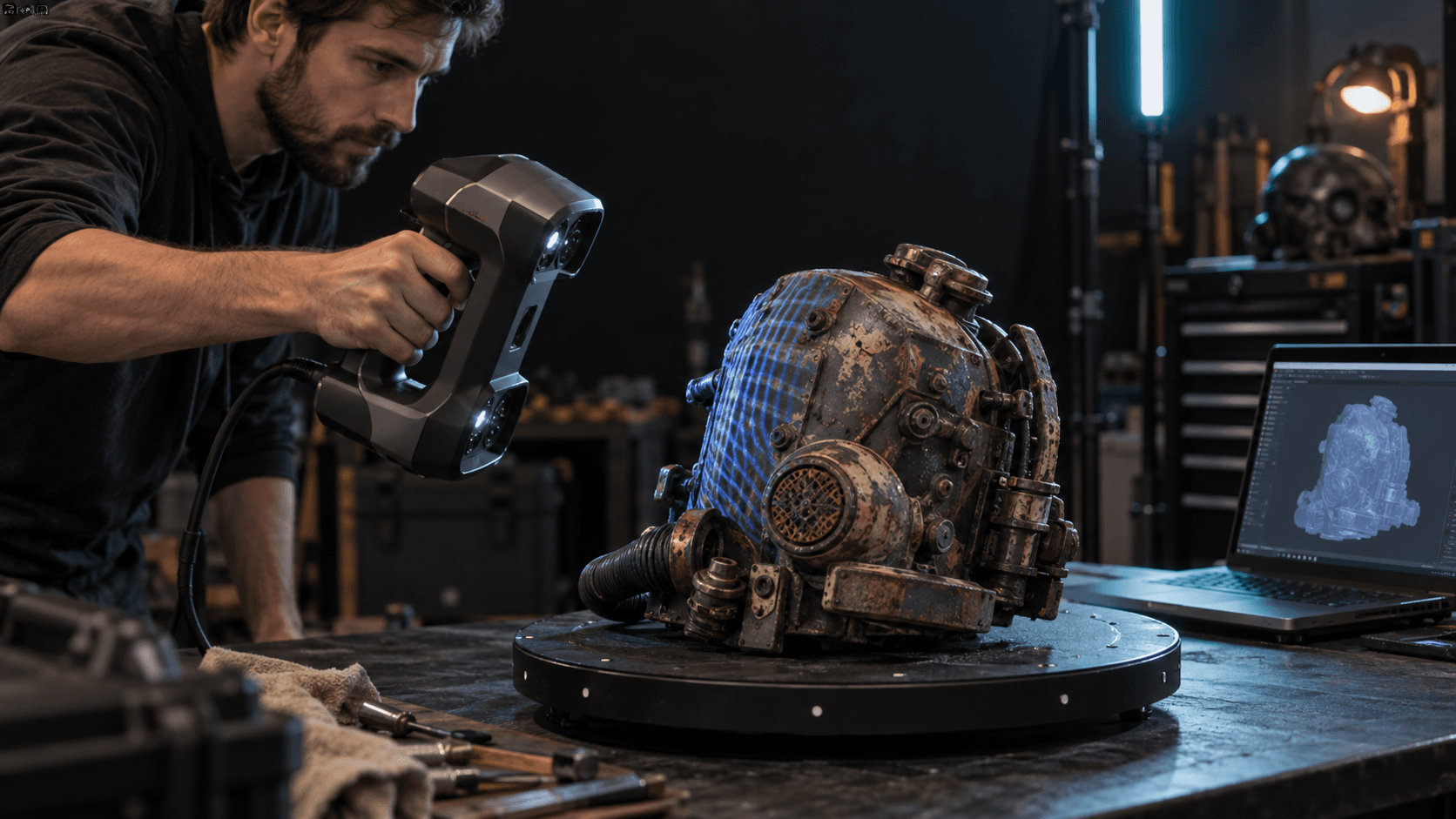
For props and industrial parts, structured light is the method we lean on most. The scanner throws a sequence of patterns onto the surface and watches, through its cameras, how those patterns bend across the shape. From that distortion it works out a precise 3D coordinate for every point it can see.
On current professional kit, accuracy sits around 0.02–0.05mm for objects in the prop-to-component range. That's finer than your eye can pick out at normal viewing distance.
One scan only ever sees one side. We take several from different angles and stitch them together into a full model — minutes of work for something simple, longer when there's complex geometry and tight internal detail to chase.
On a film or TV job
Replication is the one we're asked for most. There's an original — often a hero piece a traditional maker built by hand — and the production needs more of them. A scan captures that original exactly and gives you a file you can reprint as many times as you like, every copy identical. It beats measuring by hand on both speed and accuracy, and it holds onto the actual design rather than a close-enough approximation.
Scale variants and digital doubles fall straight out of the same data. A scanned prop can shrink to a tabletop miniature, grow into a background piece, or get a quiet tweak for a period-correct version — no return trip to the original maker.
Performer scanning is the same technology at full-body size. Scan a performer and the costume and SFX teams get an accurate reference for pattern cutting, prosthetic bases and costume engineering, without the time, mess and discomfort of a traditional lifecast.
On an industrial job
Reverse engineering starts with a part in your hand and needs to finish as a CAD model. It comes up constantly — legacy components with no surviving drawings, a competitor's part you need to understand, a bought-in component you're designing around. The scan gives you the geometry; CAD reconstruction, whether straight off the mesh or by fitting surfaces to it, turns that into the deliverable.
Quality inspection uses scanning to check a finished part against what it was meant to be. Deviations as small as 0.05mm show up as a colour map across the surface, flagging trouble spots that would take hours to hunt down by hand.
Documentation and archiving captures an object exactly as it is today. Museums, heritage groups and manufacturers sitting on complex tooling all get value from a digital record that outlives the physical thing.
What scans well, and what fights you
Structured light is happiest on matte, opaque surfaces with a bit of shape to them. Shiny surfaces — polished metal, chrome, glass — scatter the projected pattern and scan badly until you knock them back with a temporary scanning spray. Very dark surfaces swallow the light instead of bouncing it, with much the same result.
Clear and translucent materials — clear resin, glass, some silicones — won't scan at all without that surface treatment.
Organic shapes, texture and deep undercuts are all easy. Funnily enough, it's the simple-looking prismatic machined parts — dead-flat faces, crisp edges — that can be the awkward ones. For geometry that plain, rebuilding it in CAD is often quicker than scanning it.
On-site scanning
When the object can't come to us — a big set piece, a permanently installed machine, a performer who needs scanning in a working studio — we'll bring the scanner to you. Get in touch and we'll sort out the logistics.
Need 3D Printing Services?
Get in touch for a free consultation and quote on your project.
Request a Quote